What Is the IEC 60320 Standard? A Guide to C5, C7, C8, C13, C14, C15, C16, C19 and C20 Power Cables
Although power cables used in electrical and electronic devices may look similar from the outside, they can differ significantly in terms of connection type, intended application, temperature resistance, current capacity, and cable construction.
IEC power cables are widely used in computers, monitors, servers, UPS systems, PDUs, data centers, televisions, audio systems, and industrial equipment. These cables are manufactured according to specific international standards.
One of the most important standards in this area is IEC 60320.
As Power Kablo, we manufacture AC power and power cables, molded and corded cables, and power cable solutions for different electronic devices. Our AC Power and Power Cables product range includes different connection options such as C5-C14, C7-C8, C13-C14, C19-C20, C14-C19, and C13-C20. (Plugged Cable, Spiral Cable)
What Is IEC 60320?
IEC 60320 is a family of international standards covering appliance couplers and interconnection components used with electrical equipment.
The standard classifies appliance inlets and connectors according to defined physical and electrical characteristics. This makes it possible to use standardized connections between equipment and power cables.
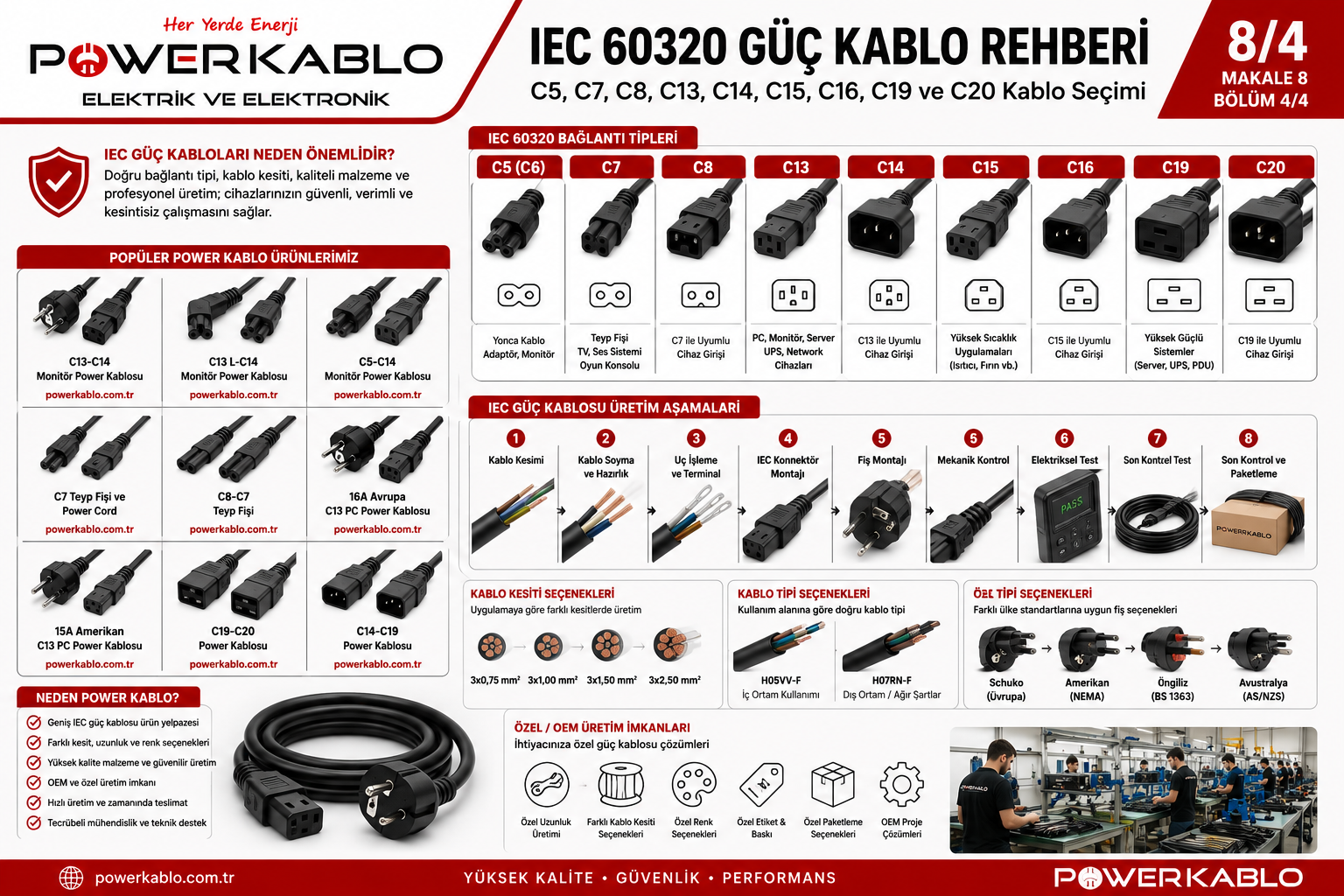
The IEC 60320 family includes many different connection types. Among the most commonly encountered are:
C5
C7
C8
C13
C14
C15
C16
C19
C20
However, these connections are not interchangeable and are not intended for the same applications.
For example:
C5-C14 Monitor Power Cable → certain monitors and electronic devices
C7 Power Cord → televisions, audio systems, game consoles, and small electronic devices
C13 PC Power Cable → computers and electronic equipment
C15/C16 → applications where higher operating temperatures are important
C19-C20 Power Cable → professional systems requiring higher power
What Are the Main IEC 60320 Connection Types?
The easiest way to understand the IEC 60320 family is to examine the connector pairs according to their applications.
C5 and C6
C5 is commonly known as the cloverleaf connector, cloverleaf cable, or Mickey Mouse connector.
Power Kablo offers products such as the C5-C14 Monitor Power Cable. The product information specifies values such as a 10 A rated current and 250 V rated voltage. (Plugged Cable, Spiral Cable)
C5 connections can commonly be found in:
Notebook power adapters
Monitors
Small electronic devices
Adapters
Certain portable electronic equipment
Important characteristic of C5
C5 has a three-contact, grounded configuration.
Therefore, it should not be confused with the two-pin C7 connection.
What Are C7 and C8?
C7 is one of the most widely used IEC connection types in consumer electronics.
Because of its shape, it is commonly called:
Figure-8 cable
Figure-8 power cord
Tape-recorder plug
8-type cable
Power Kablo’s C7 product range describes applications including televisions, game consoles, DVD players, adapters, audio systems, and various electronic devices. (Plugged Cable, Spiral Cable)
Power Kablo also offers a C8-C7 Figure-8 Power Cable product group. (Plugged Cable, Spiral Cable)
The basic relationship between C7 and C8
C7: connector on the cable side
C8: compatible appliance inlet on the device side
Therefore, C7 and C8 form a complementary connection system, just as C13 and C14 do.
What Are C13 and C14?
The C13/C14 system is one of the best-known IEC 60320 connection systems.
In simple terms:
C13: female connector on the cable side
C14: male appliance inlet on the equipment side
For example, if the rear of a desktop computer has a C14 inlet, it can accept a power cable with a compatible C13 connector.
Power Kablo’s IEC C13 C14 Kablo Nedir? article discusses this connection system in detail. (Plugged Cable, Spiral Cable)
Power Kablo also offers products such as the 16 Amp European C13 PC Power Cable, with technical specifications for the European plug/C13 combination. (Plugged Cable, Spiral Cable)
For the American market, products such as the 15 Amp American C13 PC Power Cable use a different mains plug together with the same general C13 appliance connector family. (Plugged Cable, Spiral Cable)
C13-C14 Monitor Power Cable
One of the major applications of the C13/C14 system is computers and monitors.
Power Kablo offers a C13-C14 Monitor Power Cable product group. (Plugged Cable, Spiral Cable)
A typical configuration is:
Mains plug → cable → C13 → C14 appliance inlet
The important point is that the expression “C13 cable” does not necessarily define the complete cable assembly.
The mains plug on the other end may be:
European
American
British
Israeli
Australian
South African
and other national plug standards.
Power Kablo’s product portfolio includes power cables designed for different country standards. (Plugged Cable, Spiral Cable)
What Is a C13 L-C14 Monitor Power Cable?
In some applications, an angled or L-type C13 connector may be preferred instead of a standard straight C13.
Power Kablo offers a C13 L-C14 Monitor Power Cable product. The product information specifies values such as 10 A rated current, 250 V rated voltage, 2P+E configuration, IP20 protection, and RoHS compliance. (Plugged Cable, Spiral Cable)
The angled design can help route the cable more conveniently around certain devices and installation points.
Therefore, in applications where space or cable direction is important, it may be necessary to specify C13 L rather than simply “C13.”
What Are C15 and C16?
C15/C16 are IEC 60320 connector types similar in general appearance to C13/C14, but they are intended for applications where higher temperature conditions are relevant.
They may be encountered in applications such as:
Heaters
Ovens
High-temperature equipment
Certain professional kitchen appliances
Heat-generating electrical equipment
For these applications, the connector type alone is not enough. The cable insulation, conductor construction, and temperature rating must also be considered.
This is directly related to high-temperature cable solutions such as silicone cables. Power Kablo’s silicone cable product range includes cable solutions for applications requiring higher temperature resistance.
Note: No separately verified C15/C16 product URL has been identified in the current product information, so no unverified product link is provided here.
What Are C19 and C20?
C19/C20 is one of the larger connector systems within the IEC 60320 family.
C19: female connector on the cable side
C20: male appliance inlet on the equipment side
C19/C20 connections are commonly encountered in professional systems requiring higher power, including:
Servers
UPS systems
PDUs
Data center equipment
Professional network infrastructure
High-power electronic equipment
Power Kablo’s IEC C19 C20 Güç Kablosu Nedir? article discusses this connection system separately. (Plugged Cable, Spiral Cable)
C19-C20 Power Cable
Power Kablo’s C19-C20 Power Cable product group is included in the AC Power and Power Cables category. (Plugged Cable, Spiral Cable)
The product portfolio includes combinations such as:
3×1.5 mm² – 1.5 m
3×2.5 mm² – 1.5 m
3×1.5 mm² – 3 m
3×2.5 mm² – 3 m
This demonstrates that cable selection is not only about the connector type. Conductor cross-section and cable length are also important.
What Is a C14-C19 Power Cable?
The two ends of an IEC power cable do not necessarily have to use the same connector type.
Power Kablo also offers C14-C19 Power Cable products. (Plugged Cable, Spiral Cable)
Available combinations include:
3×1 mm² – 1.5 m
3×1.5 mm² – 1.5 m
3×1 mm² – 3 m
3×1.5 mm² – 3 m
For this reason, when ordering an IEC cable, it is much more accurate to specify both connector ends instead of simply saying “C19 cable.”
What Is a C13-C20 Power Cable?
Power Kablo’s AC Power and Power Cables product group also includes C13-C20 Power Cable products. (Plugged Cable, Spiral Cable)
In this configuration:
C13 → cable side
C20 → equipment side
For special combinations such as this, it is essential to verify that the device connections are actually designed for the specified configuration.
Why Are C13, C15 and C19 Sometimes Confused?
One of the main reasons is that some IEC connector types have similar external shapes.
However:
C13/C14 → widely used with general electronic equipment
C15/C16 → intended for applications where higher temperatures are relevant
C19/C20 → designed for higher-power professional systems
Therefore, product selection should never be based simply on whether the connector “looks like it fits.”
The equipment manufacturer’s specified connector type should always be the primary reference.
Cable Cross-Section in IEC Power Cables
Even when the connector is correct, the cable may not be suitable if the conductor cross-section is inappropriate.
For example, Power Kablo’s catalog includes C19-C20 products with:
3×1.5 mm²
3×2.5 mm²
Cable cross-section should be selected according to factors such as:
Equipment power consumption
Operating current
Cable length
Ambient temperature
Installation and usage conditions
Applicable technical requirements
A 3×2.5 mm² cable is not automatically the correct choice simply because it has a larger cross-section than a 3×1.5 mm² cable.
The appropriate conductor size should be determined according to the actual application requirements.
The Mains Plug Is Also Part of IEC Cable Selection
An IEC connector identifies only part of the complete cable assembly.
The mains plug on the other side can vary according to the destination market.
For example, Power Kablo’s product portfolio includes combinations such as:
European plug + C13
American plug + C13
British plug + C13
Australian plug + C13
Israeli plug + C13
South African plug + C13
Thus, a 16 Amp European C13 PC Power Cable and a 15 Amp American C13 PC Power Cable may use the same general C13 connector family while having different mains plugs. (Plugged Cable, Spiral Cable)
Schuko Plug + IEC Cable
Schuko-plugged IEC power cables are widely encountered in Türkiye and many European applications.
Typical configurations include:
Schuko → C13
Schuko → C19
Power Kablo’s Schuko Fiş Nedir? content also discusses the relationship between Schuko plugs and IEC C13/C19 connections. (Plugged Cable, Spiral Cable)
For grounded equipment, however, having a grounded plug alone is not sufficient. The equipment and installation must also have an appropriate protective earthing system.
IEC Power Cable Manufacturing at Power Kablo
Power Kablo does not only supply standard catalog products. As a manufacturer, we can also evaluate customized power cable requirements.
For example, an OEM customer may require:
C13 + special plug + 2 m + special conductor cross-section
Another project may require:
C19 + 3×2.5 mm² + special length
A different customer may require:
C7 + European plug + special color + special length
For IEC power cable orders, customized dimensions, cable lengths, plug types, conductor cross-sections, colors, and OEM production requirements can therefore be evaluated in addition to standard catalog products.
Power Kablo’s About Us information lists a broad product portfolio including C5, C7, C8, C13, C14, C19, C20, and various power cord product groups. (Plugged Cable, Spiral Cable)
Seven Important Checks When Selecting an IEC Power Cable
Before purchasing an IEC power cable, it is useful to check the following seven points:
What is the appliance inlet?
C14?
C16?
C20?
What is the cable-side connector?
C13?
C15?
C19?
What is the mains plug?
European?
American?
British?
Another national standard?
What is the conductor cross-section?
3×1.5 mm²?
3×2.5 mm²?
What is the cable length?
1 m?
1.5 m?
3 m?
A custom length?
What is the operating environment?
Standard office environment?
High temperature?
Server rack?
Industrial machinery?
Is a standard product sufficient or is custom production required?
Standard catalog product?
Custom cross-section?
Custom length?
Custom plug?
OEM production?
IEC C5, C7, C8, C13, C14, C15, C16, C19 and C20: Technical Differences
IEC 60320 connector types can appear similar at first glance, but C5, C7, C8, C13, C14, C15, C16, C19 and C20 have different technical characteristics and applications.
When selecting an IEC power cable, it is not enough to ask whether the connector physically fits. The equipment inlet, cable construction, operating temperature, power requirement, and intended application should all be considered.
Power Kablo’s AC Power and Power Cables product group includes various solutions for C5, C7, C8, C13, C14, C19 and C20 connections. (Power Kablo)
C5 and C6
C5 is commonly known as the cloverleaf or Mickey Mouse connector.
Power Kablo offers a C5-C14 Monitor Power Cable. Its product information specifies characteristics such as:
10 A rated current
250 V rated voltage
2P+E grounding configuration
IP20 protection
(Power Kablo)
C5 may be used with:
Notebook adapters
Monitors
Small electronic devices
Adapters
Portable electronic equipment
Why C5 Is Different
C5 is a three-contact, grounded connector.
It should therefore not be confused with the two-contact C7.
C7 and C8
C7 is one of the most familiar power connectors in consumer electronics.
It is commonly referred to as:
Figure-8 cable
Figure-8 power cord
Tape-recorder plug
8-type cable
Power Kablo’s C7 product information describes applications including televisions, game consoles, DVD players, adapters, audio systems, and various electronic devices. (Power Kablo)
Power Kablo also offers a C8-C7 product group. (Power Kablo)
The basic relationship is:
C7 → cable-side connector
C8 → appliance inlet
What Devices Use C7 Cables?
C7 connections are widely used in low- and medium-power electronic equipment, including:
Televisions
Some televisions use C7 power connections.
Game Consoles
C7 power cords can be used with compatible game consoles.
Audio Systems
Audio systems, media players, and some professional audio equipment may use C7 connections.
Adapters
Some electronic power adapters use C7 connections.
DVD and Media Players
Various media devices may use C7/C8 connections.
The manufacturer’s specified connector should always be checked before selecting a replacement cable.
C5 vs. C7
Feature C5 C7
Common name Cloverleaf / Mickey Mouse Figure-8
Contacts 3 2
Grounding Yes No
Typical applications Adapters, monitors, electronic equipment TV, audio, media equipment
Example C5-C14 Monitor Power Cable C7 Power Cord
If a device has a C7/C8 inlet, a C5 cable is not the appropriate choice.
C13 and C14
C13/C14 is one of the most commonly encountered IEC connection systems.
C13: female cable-side connector
C14: male equipment-side inlet
Power Kablo offers C13-C14 Monitor Power Cable products in different configurations. (Power Kablo)
The company also offers the 16 Amp European C13 PC Power Cable, with specifications including the European C13 configuration, 250 V rated voltage, and a stated 10–16 A current range in the product information. (Power Kablo)
Where Is C13 Used?
C13 is widely used with professional electronic equipment such as:
Desktop computers
Monitors
Servers
UPS systems
PDUs
Network equipment
Storage systems
Professional electronic equipment
This is why the term “C13 PC Power Cable” is frequently used in computer power cable searches.
What Is C13 L?
In addition to the standard straight C13, angled C13 L connectors are available.
The C13 L configuration can offer advantages where the cable needs to be routed differently around the equipment or within a limited installation space.
Power Kablo offers a C13 L-C14 Monitor Power Cable. Its product information specifies values including 10 A rated current, 250 V rated voltage, and 2P+E configuration. (Power Kablo)
A 16 Amp European C13 L PC Power Cable is also available as a product option. (Power Kablo)
C13 vs. C15
C13 and C15 can look quite similar.
However:
C13/C14 → general electronic equipment
C15/C16 → applications where higher temperatures are relevant
C15/C16 may be encountered in:
Heaters
Ovens
Professional kitchen equipment
Heat-generating equipment
Certain high-temperature electrical applications
Important
The fact that C15 looks similar to C13 does not mean they can be freely substituted.
The equipment manufacturer’s specified connector type should always be followed.
The cable’s insulation material and temperature rating should also be appropriate for the application.
C15 and C16
Within the IEC system:
C15 → cable-side connector
C16 → appliance inlet
Temperature conditions are particularly important for C15/C16 applications.
Therefore, the connector alone should not be evaluated. Cable insulation, temperature resistance, and conductor construction should also be considered.
Power Kablo’s silicone cable product range may be relevant when high-temperature cable construction is required.
Note: No separately verified C15/C16 product page has been identified in the available Power Kablo product information, so no product URL is provided here.
C19 and C20
C19/C20 is one of the larger IEC 60320 connection systems.
C19 → cable-side connector
C20 → equipment-side inlet
These connections are commonly found in high-power professional systems, including:
Servers
UPS systems
PDUs
Data center equipment
Network infrastructure
High-power electronic systems
Power Kablo’s IEC C19-C20 Power Cable content provides additional information about this connection system. (Power Kablo)
Why Is C19/C20 Larger Than C13/C14?
C19/C20 connectors are physically larger and are designed for higher-power applications.
Power Kablo’s catalog includes C19-C20 products with:
3×1.5 mm² – 1.5 m
3×2.5 mm² – 1.5 m
3×1.5 mm² – 3 m
3×2.5 mm² – 3 m
This shows why both cable cross-section and length must be considered in addition to the connector type. (Power Kablo)
C14-C19 Power Cable
The two ends of a power cable do not necessarily have to use matching IEC connector families.
Power Kablo’s catalog includes C14-C19 Power Cable products. (Power Kablo)
These include combinations such as:
3×1 mm²
3×1.5 mm²
1.5 m
3 m
These cables can be useful in professional systems where equipment with different IEC connection types needs to be interconnected.
C13-C20 Power Cable
Another special configuration is the C13-C20 Power Cable.
Power Kablo’s product group includes this connection. (Power Kablo)
One end uses C13 while the other uses C20.
As with all non-standard combinations, the equipment’s specified inlet and connection requirements should be verified before selecting the cable.
Why Is the Mains Plug Important?
The IEC connector describes only the equipment-side portion of the cable.
The mains plug may vary according to the country or market.
Examples include:
European plug + C13
American plug + C13
British plug + C13
Australian plug + C13
Israeli plug + C13
South African plug + C13
For export-oriented manufacturers, specifying both the IEC connector and the national mains plug is particularly important.
Schuko-C13 Connection
Schuko + C13 is a common power cable configuration in Türkiye and Europe.
The structure is:
Schuko → mains side
C13 → equipment side
Power Kablo’s Schuko-plugged cable content also discusses the use of Schuko-C13 configurations. (Power Kablo)
For grounded equipment, the entire protective earthing system must be suitable; a grounded plug alone does not guarantee an appropriate protective earth connection.
How Is IEC Cable Cross-Section Determined?
Cable cross-section is one of the most commonly overlooked factors in IEC power cable selection.
Possible conductor configurations include:
3×0.75 mm²
3×1 mm²
3×1.5 mm²
3×2.5 mm²
The appropriate size depends on:
Equipment current
Power consumption
Cable length
Ambient temperature
Cable construction
Installation conditions
Applicable standards
This is particularly important for high-power C19/C20 applications.
Custom IEC Cable Production
Not every customer requirement can be met with a standard catalog product.
For example, a customer may require:
C19-C20 + 3×2.5 mm² + 4 m
or:
European plug + C13 L + 2.5 m
In such cases, custom production can be considered rather than restricting the application to standard catalog lengths.
As a manufacturer, Power Kablo can evaluate requirements involving:
Custom cable length
Different conductor cross-section
Different IEC connector
Different national plug
Custom color
OEM production
Production according to technical specifications
Power Kablo’s C7 Power Cord content also refers to options such as different cable lengths, custom colors, different plug standards, and OEM production. (Power Kablo)
How to Select the Correct IEC Power Cable
Selecting an IEC power cable should begin with the equipment inlet.
If the equipment has:
C8 → use the compatible C7 cable
C14 → use the compatible C13 cable
C16 → use the compatible C15 cable
C20 → use the compatible C19 cable
However, the equipment manufacturer’s technical documentation should always take priority over visual inspection.
C13 or C15?
This is especially important in equipment operating at elevated temperatures.
C13/C14
Commonly used with:
Computers
Monitors
Servers
UPS systems
Network equipment
Electronic equipment
C15/C16
Can be encountered in:
Heaters
Ovens
Heat-generating equipment
Professional kitchen equipment
Certain high-temperature applications
A device operating in a warm environment does not automatically require C15. The manufacturer’s specified connector and the cable’s temperature rating must be checked.
Can C13 and C15 Be Used Interchangeably?
They should not be treated as interchangeable simply because their physical shapes are similar.
For a high-temperature application, using a standard C13-C14 monitor power cable may be inappropriate if the equipment specifies a C15/C16 connection.
Conversely, if equipment is designed for C13, a different IEC connector should not be selected merely because it appears to fit.
Correct selection = specified appliance connector + appropriate cable construction.
C19 or C13?
This question often arises in server and professional power systems.
C13
C13 is commonly used in:
PCs
Monitors
Servers
UPS systems
Network equipment
General electronic equipment
C19
C19 is more frequently associated with higher-power professional systems such as:
Large server systems
UPS systems
PDUs
Data center equipment
High-power network systems
Power Kablo’s IEC C19-C20 Power Cable content provides additional information about these applications. (Power Kablo)
How Can C13 and C19 Be Distinguished?
C13 is physically smaller, while C19 is larger and designed for higher-power applications.
Nevertheless, particularly in professional installations and mass production, the connector should be identified from the equipment documentation rather than relying solely on a photograph.
C14 or C20?
C14 and C20 are appliance-side male IEC inlets.
C14
C14 is compatible with C13.
A typical configuration is:
European mains plug → cable → C13 → C14 equipment inlet
Power Kablo’s C13-C14 Monitor Power Cable product group is a common example. (Power Kablo)
C20
C20 is compatible with C19.
A typical configuration is:
Mains plug → cable → C19 → C20 equipment inlet
Power Kablo’s C19-C20 Power Cable product group provides products for this configuration. (Power Kablo)
Cable Cross-Section in IEC Cable Selection
Connector type is only one part of the specification.
Available conductor sizes may include:
3×0.75 mm²
3×1 mm²
3×1.5 mm²
3×2.5 mm²
Power Kablo’s catalog includes 3×1.5 mm² and 3×2.5 mm² options for C19-C20 products, and 3×1 mm² and 3×1.5 mm² options for C14-C19 products. (Power Kablo)
Therefore, instead of ordering simply:
“I need a C19 cable.”
it is better to provide a complete technical description such as:
C19-C20 / 3×2.5 mm² / 3 m
3×1.5 mm² or 3×2.5 mm²?
A larger conductor is not automatically the correct solution.
The appropriate cross-section should be determined according to:
Equipment current
Power rating
Cable length
Ambient temperature
Installation conditions
Applicable standards
The availability of both 3×1.5 mm² and 3×2.5 mm² C19-C20 products demonstrates that different applications can require different conductor sizes. (Power Kablo)
Cable Length Also Matters
Cable length should be specified along with the connector type and conductor cross-section.
Typical lengths may include:
1 m
1.5 m
2 m
3 m
5 m
Power Kablo’s C19-C20 product range includes 1.5 m and 3 m options, while C14-C19 products are also available in 1.5 m and 3 m configurations. (Power Kablo)
If the required length differs from the standard catalog options, custom-length production can be considered.
This can be particularly valuable for OEM manufacturers, machine builders, and companies producing equipment in volume.
Specify the Mains Plug When Ordering
The fact that a cable has a C13 connector does not define the complete cable assembly.
For example:
European plug + C13
and
American plug + C13
use the same general IEC connector family while having different mains plugs.
Power Kablo offers both 15 Amp American C13 PC Power Cable and 16 Amp European C13 PC Power Cable products. (Power Kablo)
This distinction is especially important for export-oriented manufacturers.
C5 or C7?
Similar confusion can occur with smaller electronic devices.
C5
Three contacts
Grounded
Cloverleaf/Mickey Mouse shape
Power Kablo’s C5-C14 Monitor Power Cable is an example. (Power Kablo)
C7
Two contacts
Ungrounded
Figure-8 shape
Power Kablo’s C7 Power Cord is an example. (Power Kablo)
Therefore, if the equipment requires a grounded connection, the C5/C7 distinction is particularly important.
What Information Should Be Provided When Ordering an IEC Power Cable?
When requesting an IEC power cable from a manufacturer, providing the following information can make the process faster and more accurate:
IEC connector type
C13
C19-C20
C13-C20
etc.
Mains plug
Schuko
European
American
British
Other national standard
Conductor cross-section
For example, 3×1.5 mm²
Cable length
For example, 3 m
Cable type
For example, H05VV-F
Or another cable type appropriate to the application
Operating environment
Normal environment
High temperature
Server room
Industrial environment
Quantity
100 pcs
1,000 pcs
10,000 pcs
Custom production requirements
Special color
Special printing
Special length
Special plug
OEM requirements
IEC Power Cable Production at Power Kablo
Not every application can be solved with a standard catalog product.
For example, a customer may require:
European plug + C19 + 3×2.5 mm² + 4 m
Another customer may require:
C13 L + custom length + special cable type
An OEM manufacturer may require:
Custom plug + specified IEC connector + specified cross-section + specified length
As a manufacturer, Power Kablo can evaluate such customized cable requirements according to the customer’s technical specification.
What Does IEC Power Cable Manufacturing Involve?
A reliable IEC power cable may appear simple, but its production involves multiple stages.
Before production begins, the customer’s technical requirements should be defined.
A request such as:
“I need a C13 cable.”
is often insufficient.
Where applicable, production specifications should include:
IEC connector type
Mains plug
Cable cross-section
Cable type
Cable length
Conductor construction
Color
Operating environment
Voltage
Current
Required standards
Quantity
Custom production requirements
For example:
European plug + C13 + 3×1.5 mm² + 2 m
or:
C19-C20 + 3×2.5 mm² + 3 m
Power Kablo’s catalog includes 3×1.5 mm² and 3×2.5 mm² C19-C20 products and 3×1 mm² and 3×1.5 mm² C14-C19 products. (Power Kablo)
Why Is Conductor Cross-Section Important?
One of the most important components of a power cable is its conductor.
Different applications may use:
3×0.75 mm²
3×1 mm²
3×1.5 mm²
3×2.5 mm²
The appropriate conductor size depends on the equipment’s electrical requirements and the installation conditions.
A larger conductor is not automatically better. The correct choice depends on current, power, length, temperature, installation, and applicable requirements.
This is particularly important in C19-C20 high-power applications.
Copper Conductor Quality
The conductor directly affects the electrical performance of the power cable.
Relevant characteristics include:
Conductor cross-section
Conductivity
Flexibility
Individual wire diameter
Number of strands
Copper properties
Conductor quality is particularly important in equipment operating continuously under load.
For this reason, power cable quality should not be judged solely by external appearance.
Cable Insulation
The insulation surrounding the conductor is another critical component.
The insulation material may be selected according to:
Operating temperature
Mechanical resistance
Flexibility
Installation environment
Voltage requirements
Chemical exposure
A standard office environment and a high-temperature industrial application may require completely different cable constructions.
For high-temperature applications, solutions such as silicone cables may be considered.
This is particularly relevant for applications involving C15/C16 connectors, where both the connector and cable temperature rating should be evaluated.
Selecting C13, C15 and C19 Connectors
Correct connector selection is one of the most important production stages.
C13
Widely used in computers, monitors, and various electronic equipment.
Power Kablo’s 16 Amp European C13 PC Power Cable combines a European mains plug with a C13 connector. (Power Kablo)
C15
Used in applications where higher operating temperatures are relevant.
C19
Commonly encountered in higher-power professional systems such as servers, UPS systems, and PDUs.
Power Kablo’s IEC C19-C20 Power Cable content provides additional information about the C19/C20 system.
C13 L and Other Special IEC Connectors
Not every application is suitable for a standard straight C13.
In some installations, an angled C13 L connector may make cable routing easier and improve compatibility with the available space.
Power Kablo offers a C13 L-C14 Monitor Power Cable with specifications including 10 A rated current, 250 V rated voltage, and 2P+E configuration. (Power Kablo)
A 16 Amp European C13 L PC Power Cable is also available.
Mains Plug Assembly
The mains plug is another important component of an IEC power cable.
Depending on the application, manufacturers may use:
European plugs
Schuko plugs
American plugs
British plugs
Australian plugs
Other national standards
For example, Power Kablo offers both 15 Amp American C13 PC Power Cable and 16 Amp European C13 PC Power Cable products.
Therefore, export production requires correct selection of both the IEC connector and the destination country’s mains plug.
Cable Stripping and Terminal Preparation
During production, the cable ends must be prepared appropriately.
Depending on the product design:
The cable is cut to the specified length.
The outer jacket is stripped to the required dimension.
The conductors are prepared.
Terminals may be applied where required.
The IEC connector or mains plug is assembled.
Care must be taken not to damage the conductor during stripping.
Cutting or damaging conductor strands during preparation can negatively affect both electrical and mechanical performance.
IEC Connector Assembly
After cable preparation, the IEC connector is assembled.
For example, in a C13-C14 power cable, the C13 connector must be correctly attached to the cable.
The same principle applies to C19-C20 assemblies, where the correct C19 and C20 components must be matched and assembled properly.
Why Is Mechanical Connection Important?
A reliable power cable requires more than an electrically correct connection.
The mechanical connection between the cable and connector must also withstand the intended use.
Appropriate cable retention and strain-relief construction help prevent damage when the cable is pulled or subjected to mechanical stress.
This is particularly important in:
Machine cables
Continuously moving cables
Rack systems
Industrial equipment
Frequently connected and disconnected power cables
Cable Length Control
The finished cable length must match the customer’s specification.
Standard products may be manufactured in predefined lengths, while custom production can accommodate application-specific dimensions.
Possible lengths may include:
1 m
1.5 m
2 m
3 m
5 m
or another length specified in the customer’s technical documentation.
Custom lengths can be particularly valuable in OEM applications where the cable must fit precisely inside a device or rack system.
Quality Control of IEC Power Cables
Final quality control is one of the most important stages of manufacturing.
Depending on the product and applicable requirements, checks may include:
Visual inspection
Is the correct mains plug installed?
Is the correct IEC connector installed?
Is there any visible deformation?
Is the product clean and properly assembled?
Are markings correct?
Dimensional inspection
Is the cable length correct?
Is the connector orientation correct?
Is the conductor cross-section consistent with the order?
Electrical inspection
Conductor continuity
Protective earth continuity
Polarity
Insulation
Other required electrical tests
The exact scope of testing should be determined according to the intended application and applicable technical requirements.
What Is Checked in a C13-C14 Cable?
For example, consider a C13-C14 Monitor Power Cable.
The production inspection may include:
Is the C13 connector correct?
Is the mains plug correct?
Are phase, neutral, and protective earth connections correct?
Is the conductor cross-section correct?
Is the cable length correct?
Is the mechanical assembly secure?
Have the required electrical tests been passed?
These controls help maintain consistency across mass-produced cable assemblies.
Why Is Quality Especially Important in C19-C20 Cables?
C19-C20 Power Cables are commonly used in higher-power professional systems, making correct technical selection particularly important.
Power Kablo’s catalog includes C19-C20 products in:
3×1.5 mm²
3×2.5 mm²
1.5 m
3 m
configurations. (Power Kablo)
For higher-power applications, conductor cross-section, connector components, cable construction, and operating conditions should all be evaluated together.
OEM Production of IEC Power Cables
OEM production is an important application area for IEC power cables.
An equipment manufacturer may require a cable that differs from standard catalog products.
For example:
European plug + C13 + 3×1.5 mm² + 2.2 m + custom color
or:
C19-C20 + 3×2.5 mm² + 4 m
The following characteristics can be defined according to the technical specification:
Cable length
Cross-section
Mains plug
IEC connector
Color
Cable type
Labeling
Packaging
As a manufacturer, Power Kablo can evaluate customized cable and OEM requirements.
Custom Cable Cross-Sections
Standard catalog dimensions may not always be sufficient for companies manufacturing equipment in volume.
A customer may require:
a different cross-section instead of 3×1.5 mm²
or:
4.5 m instead of 3 m
Such requirements can be evaluated as custom production according to the applicable technical specification.
This is one of the advantages of working with a manufacturer rather than limiting the project to standard off-the-shelf products.
Custom-Length IEC Cable Production
A cable that is unnecessarily long can cause:
Cable clutter
Unnecessary material consumption
Poor organization inside racks and panels
A cable that is too short can create installation problems.
Therefore, application-specific cable lengths can provide significant advantages in:
Server racks
UPS systems
PDUs
Industrial machinery
Automation systems
Electronic equipment manufacturing
Power Kablo can evaluate custom-length power cable production according to the customer’s technical requirements.
Production for Different National Standards
The IEC connector can remain the same while the mains plug changes according to the destination market.
For example:
European plug + C13
American plug + C13
British plug + C13
can be produced as different configurations.
Power Kablo’s AC Power and Power Cables product group includes various options for different national plug standards. (Power Kablo)
This is particularly important for equipment manufacturers exporting to different markets.
Why Choose Power Kablo?
One of the main advantages of working with a manufacturer for IEC power cables is the ability to develop solutions beyond standard catalog products.
Power Kablo works with requirements involving:
C5
C7
C8
C13
C14
C19
C20
Different mains plugs
Different conductor cross-sections
Custom cable lengths
OEM production
The complete product portfolio can be reviewed through the Power Kablo AC Power and Power Cables category.
Conclusion: An IEC Power Cable Is More Than a Plug and a Cable
A reliable IEC power cable requires consideration of several elements together:
Correct IEC connector
Correct mains plug
Correct conductor cross-section
Correct cable type
Correct cable length
Reliable mechanical assembly
Appropriate quality controls
This is especially important for professional configurations such as C13-C14, C19-C20, C13-C20, and C14-C19.
As Power Kablo, we provide IEC power cables, plugged cables, C5, C7, C8, C13, C14, C19, C20, and customized cable combinations. In addition to standard products, we can evaluate custom production and OEM solutions based on required dimensions, conductor cross-section, cable length, mains plug, IEC connector, and other technical specifications.
IEC Power Cable Manufacturing: A Technical Overview
In a future article, we can examine the cable types used in IEC power cables—including H05VV-F, H07RN-F, silicone cables, and other cable constructions—and discuss which cable type is appropriate for different environments and how conductor cross-section should be determined.
© 2019 Copyright 2021, Power Kablo.