What Is a Power Cord with Plug? Types of Power Cords with Plugs and Their Applications
One of the most important products used to ensure safe and proper power connections in electrical and electronic devices is the power cord with plug. A power cord with plug is a ready-to-use cable solution that allows a device to receive electrical power from the mains and has a suitable connection component at one or both ends.
As a manufacturer, Power Kablo produces power cords with plugs suitable for different country standards, current ratings, cable cross-sections, and device connections. In addition to standard products, we can also provide custom cable lengths, custom cross-sections, different plug types, and OEM production solutions according to customer requirements.
What Is a Power Cord with Plug?
In its simplest definition, a power cord with plug is a cable used to transfer electrical energy from a power source to a device and equipped with a suitable electrical plug.
A power cord with plug generally consists of:
Plug
Electrical cable
Conductive cores
Insulation
Outer cable sheath
Device connection connector, when required
For example, a product may be:
European Plug → C13
Another product may be:
UK Plug → C13
or:
European Plug → C19
Power Kablo’s power cord product group includes solutions for different plug standards and power connections.
Where Are Power Cords with Plugs Used?
Power cords with plugs have a very wide range of applications.
For example:
Computers
Monitors
Televisions
Printers
UPS systems
Server systems
PDU systems
Electronic devices
Industrial machines
Lighting products
Adapters
Medical devices
Hotel equipment
Home electronics
OEM devices
For this reason, there is no single standard for a “power cord with plug.”
The plug type, cable type, cross-section, length, and device connection may vary depending on the application.
Power Cord with Plug Types at Power Kablo
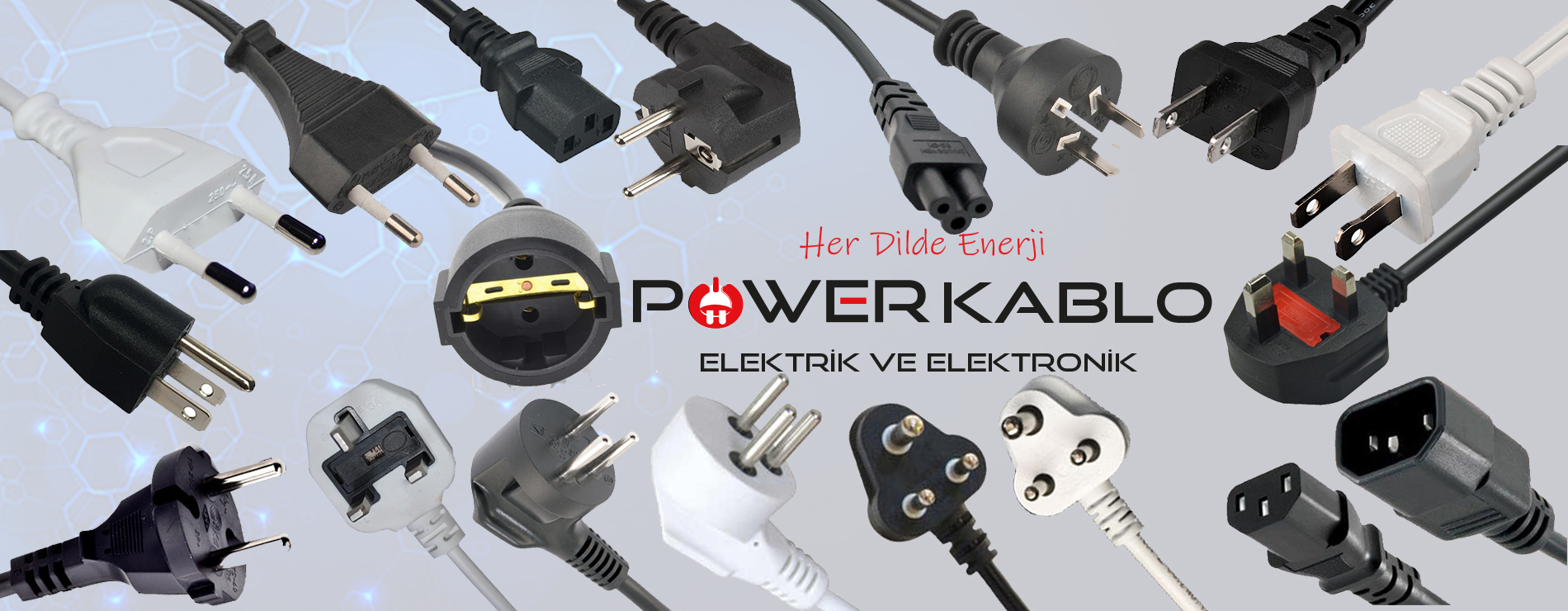
Power Kablo’s product portfolio includes power cord solutions designed for different country and application standards.
The product portfolio includes product groups such as:
2.5 A European Plug Power Cord
10 A European Plug Power Cord
16 A European Plug Power Cord
13 A UK Plug Power Cord
US Plug Power Cord
Australian Plug Power Cord
Israeli Plug Power Cord
South African Plug Power Cord
Arabic Plug Power Cords
Therefore, selecting the correct country standard is particularly important for companies engaged in export operations.
What Is a European Plug Power Cord?
European-style plugs are among the plug systems commonly used in Türkiye and many parts of Europe.
Power Kablo’s product catalog includes European plug power cords with different current ratings.
For example, the catalog includes:
PWR01 – 2×0.50 mm² – 1 meter European Plug Power Cord
PWR02 – 2×0.50 mm² – 1.20 meter European Plug Power Cord
PWR03 – 2×0.50 mm² – 1.50 meter European Plug Power Cord
Similarly, 2×0.75 mm² options are available in different lengths.
This demonstrates that when selecting a power cord, it is important to specify not only the plug type but also the cable cross-section and length.
10 A and 16 A Power Cords Are Not the Same
One of the most common mistakes when selecting power cords is treating products with different current ratings as interchangeable.
For example:
10 A European Plug Power Cord
and
16 A European Plug Power Cord
are not the same product.
The appropriate product should be selected by considering the device’s operating current, cable construction, plug specifications, and operating conditions.
Power Kablo’s content on Schuko and European-type plug power cords explains different current ratings and product selection criteria in greater detail.
Why Is Cable Cross-Section Important?
Cable cross-section must also be considered when selecting a power cord.
For example, different cable cross-sections may include:
2×0.50 mm²
2×0.75 mm²
3×0.75 mm²
3×1 mm²
3×1.5 mm²
Different cable cross-sections can be used for different applications.
Power Kablo’s catalog includes both 2×0.50 mm² and 2×0.75 mm² European plug power cords in different lengths.
Therefore, instead of simply saying:
“I need a European plug power cord.”
it is better to provide the following information whenever possible:
Plug type + current rating + cable type + number of cores + cross-section + length
The Relationship Between Power Cords with Plugs and IEC Power Cables
Many power cords with plugs are terminated with an IEC connection on the other end.
For example:
European Plug → C13
can be used with computers, monitors, and various electronic devices.
European Plug → C19
can be used in certain professional systems requiring higher power.
European Plug → C7
can be used with televisions, audio systems, and various electronic devices.
Power Kablo’s content about C13-C14 power cables and C19-C20 power cables provides more detailed information about these IEC connections.
C7 Power Cords
C7 connections are commonly found in smaller electronic devices.
C7 cables are also known in the industry as:
Figure 8 cable
Figure-8 power cord
Radio power cable
Tapered/figure-8 type power cable
Power Kablo’s content on C7 connectors and power cords explains the applications of C7 connections and the options available for different country standards.
C7 cables can be used in applications such as:
Televisions
Gaming consoles
Audio systems
Adapters
Media devices
Various electronic equipment
C5 Power Cord
Another important IEC connection is C5.
Due to its shape, the C5 connector is commonly known as a cloverleaf or Mickey Mouse connector.
Power Kablo’s product portfolio also includes C5 power cords.
Small IEC connections such as C5 and C7 are not interchangeable with larger connections such as C13 or C19.
Therefore, the device connection must be correctly identified before selecting the product.
What Should You Consider When Selecting a Power Cord with Plug?
The following information should be checked to determine the correct product:
1. What Is the Plug Type?
European, UK, US, Australian, etc.
2. What Is the Current Rating?
2.5 A, 10 A, 13 A, 16 A, etc.
3. What Is the Cable Cross-Section?
For example, 2×0.50 mm² or 2×0.75 mm².
4. What Is the Cable Length?
1 meter, 2 meters, 3 meters, or a custom length.
5. What Is the Connection on the Other End?
C7, C13, C19, female connector, or another connection type.
6. What Is the Power Requirement of the Device?
The cable and plug must be compatible with the technical requirements of the device.
Custom-Length Power Cord Production at Power Kablo
Standard products do not always meet every customer’s requirements.
For example, a customer may need:
European Plug + 2×0.75 mm² + 2.35 meters
Or a special product may be required such as:
UK Plug + C13 + 3×1.5 mm² + 3 meters
In such cases, custom production can be considered instead of limiting the solution to standard products.
As a manufacturer, Power Kablo can evaluate requirements such as:
Custom cable length
Custom cable cross-section
Different plug types
Different IEC connections
Custom colors
Custom labels
OEM production
High-volume serial production
These requirements can be evaluated according to the customer’s technical specifications.
Power Kablo: Your Power Cord Manufacturer
As Power Kablo, we provide power cords suitable for different country standards and device connections as a manufacturer.
Whether you need a standard European plug power cord, C7 power cord, C5 power cord, C13 power cable, or another connection type, we can develop a suitable solution according to the product group.
If your requirements differ from standard catalog dimensions, custom cross-sections and custom cable lengths can also be evaluated.
Power Kablo — Energy in Every Language.
Cable Type, Cross-Section, Length, and Operating Conditions in Power Cord Selection
When selecting a power cord, choosing the correct plug type alone is not sufficient. Cable cross-section, number of cores, cable type, length, operating environment, and the device’s power requirements must all be evaluated together.
Especially for companies engaged in serial production, selecting the wrong cable can lead to device incompatibility, unnecessary costs, and the need for modifications after production.
As a manufacturer, Power Kablo produces power cords with different technical specifications and provides solutions for custom dimensions, custom cross-sections, and OEM production requirements in addition to standard products.
Difference Between 2×0.50 mm² and 2×0.75 mm² Power Cords
Some of the most common cable cross-sections used in power cords are 2×0.50 mm² and 2×0.75 mm².
Here:
2 refers to the number of conductive cores.
0.50 / 0.75 mm² refers to the cross-sectional area of each conductor.
However, it is not correct to assume that a 0.75 mm² cable should always be used instead of a 0.50 mm² cable.
Cable cross-section must be determined according to the electrical requirements of the device and the applicable technical standard.
The availability of different cross-sections and cable lengths in Power Kablo’s products allows solutions to be developed for different devices and applications.
3-Core Power Cords
Three-core cables can be used in applications requiring protective grounding.
For example:
3×0.75 mm²
3×1 mm²
3×1.5 mm²
3×2.5 mm²
Different cable cross-sections can be considered for different applications.
Especially in IEC systems with grounding connections such as C13, C14, C15, C16, C19, and C20, selecting the appropriate cable construction is important.
For example, when selecting an IEC C13-C14 cable, the device’s power requirements and the cable cross-section should be evaluated together.
For professional systems requiring higher power, different connection solutions such as IEC C19-C20 power cables may be used.
H05VV-F Power Cord
H05VV-F is one of the cable types used in power cords.
H05VV-F cables are flexible and can be used for power connections in various electrical and electronic devices.
However, suitability cannot be determined from the cable designation alone.
For example, the fact that a product is:
H05VV-F + 3×1.5 mm²
does not automatically mean that it is suitable for every device.
The device’s power requirements, operating environment, and applicable technical requirements must always be considered.
Therefore, when requesting a quotation from Power Kablo, providing the technical information of the device can help determine the correct product.
Why Is Cable Length Important?
Cable length is another important specification that should be determined during production.
For one device:
1 meter
may be sufficient, while another device may require:
3 meters or 5 meters.
Especially in applications such as:
Server systems
Rack cabinets
PDU applications
Industrial machines
Laboratory equipment
OEM devices
cable lengths different from standard dimensions may be required.
For this reason, Power Kablo can evaluate custom-length production requests in addition to standard cable lengths.
Custom-Length Power Cord Production
Not every product needs to be manufactured according to standard catalog dimensions.
For example, a customer may require:
Schuko + C13 + 3×1.5 mm² + 2.40 meters
Another project may require:
UK Plug + C13 + 3×1.5 mm² + 4.50 meters
An OEM project may require:
US Plug + C19 + 3×2.5 mm² + 3 meters
For such requirements, all cable components can be evaluated according to the project specifications and included in the production plan.
Power Kablo’s AC power and power cable product group includes different connection combinations, while custom production can also be considered for non-standard requirements.
Power Cord and IEC Connection Should Be Considered Together
One of the most important factors determining where a power cord can be used is the connection on the other end of the cable.
For example:
Schuko → C13
can be used with computers, monitors, and various electronic devices.
Schuko → C19
can be used in UPS systems, PDU applications, and professional power systems.
European Plug → C7
can be used with various small electronic devices.
European Plug → C5
can be used in certain adapter and notebook applications.
For more information about C7 connections, Power Kablo’s C7 connector and power cord content can be reviewed.
For information about C13-C14 connections, the article What Is an IEC C13 C14 Cable? provides further details.
Pay Attention When Choosing C13, C15, and C19
These connections can sometimes be confused with one another.
C13
C13 is one of the most commonly used IEC device connectors and mates with C14.
C15
C15 mates with C16 and is used in certain applications where higher temperature resistance is important.
C19
C19 mates with C20 and is widely used in professional systems requiring higher power.
Therefore, instead of simply requesting an:
“IEC cable”
it is better to specify the exact connection.
For example:
C19-C20 / 3×2.5 mm² / 3 meters
is a much clearer product specification.
Power Kablo’s C19-C20 power cable content provides further information about this connection.
The Operating Environment Can Affect Cable Selection
The same power cord may not provide the same performance in every environment.
Office and Electronic Equipment
Standard power cables may be used for applications such as computers, monitors, and printers.
Servers and Data Centers
IEC connections such as C13-C14 and C19-C20 may be preferred.
Industrial Environments
Mechanical stress, temperature, movement, and other environmental conditions must be taken into consideration.
High-Temperature Applications
Instead of standard PVC cable, a different cable construction suitable for the application may be required.
Moving Applications
In systems involving continuous movement, spiral cables or other flexible cable solutions suitable for the application can be considered instead of standard fixed cables.
Can Spiral Cable and Power Cord Be Used Together?
Yes. Depending on the application, the concept of a power cord can be combined with a spiral cable.
For example, when a device is mobile, a spiral structure may be preferred to prevent the cable from continuously hanging down or lying on the floor.
Power Kablo also provides different cable solutions, including PUR spiral cables.
The important point is that the spiral cable should be selected not only for its appearance but also according to the movement and operating conditions of the device.
Color and Labeling in Power Cord Production
Cable color and identification can also become important, especially in OEM and high-volume production.
For example, a customer may require:
Black cable
Custom product label
Barcode
Product code
Company logo
Custom packaging
These details can make it easier to distinguish products from one another during serial production.
Power Kablo can evaluate such production details according to the technical specifications of OEM projects.
Why Is Working with a Manufacturer Advantageous in Power Cord Production?
There can be significant differences between purchasing ready-made products and working directly with a manufacturer.
When working with a manufacturer, the product can be evaluated according to criteria such as:
Plug type
Cable type
Cross-section
Length
IEC connection
Quantity
As a manufacturer, Power Kablo can directly transfer the customer’s technical requirements into the production process, particularly for non-standard dimensions and high-volume OEM projects.
Example Technical Specification for a Power Cord Order
Providing a product requirement in the following format can make it easier to identify the correct product:
Plug: Schuko
IEC connection: C13
Cable: H05VV-F
Cross-section: 3×1.5 mm²
Length: 3 meters
Color: Black
Quantity: 2,000 pcs
This format provides the manufacturer with a clear and understandable product specification.
If a standard product is not suitable and custom production is required, the same information can be used to evaluate the production requirements.
Standard and Custom Power Cord Production at Power Kablo
As Power Kablo, under our slogan Energy in Every Language, we manufacture power cord solutions for different country standards and device requirements.
In addition to European plug power cords, Schuko power cords, UK plug power cords, US plug power cords, and different connections such as C7, C13, and C19, custom cross-sections and custom cable lengths can also be evaluated according to customer requirements.
Especially for our OEM customers, technical specifications can be defined according to project requirements, from the plug and cable cross-section to the IEC connection and cable length.
Power Kablo — Energy in Every Language.
The Importance of Quality, Safety, Testing, and Standards in Power Cord Production
Power cords carry electrical energy directly to devices, making production quality extremely important. The plug, cable, conductor, insulation, and device connection must be compatible with one another.
Especially in serial production and OEM projects, simply having a cable that works is not enough. The product must be manufactured according to the technical specification with reliable and repeatable quality.
As a manufacturer, Power Kablo manages the power cord production process according to technical requirements, from connection type and cable cross-section to cable length and final inspections.
Why Is Quality Important in Power Cords?
A power cord can consist of many different components working together.
These may include:
Plug
Cable
Conductors
Insulation
Outer cable sheath
IEC connector
Terminal connections
Molded connection points, when required
Unsuitable materials or manufacturing defects in any of these components can affect product reliability.
Therefore, power cord production requires attention not only to the finished product but also to every stage of the manufacturing process.
The Plug and Cable Must Be Compatible
For a power cord to operate correctly, the plug must be technically compatible with the cable.
For example, when using a 3×1.5 mm² cable, selecting a plug based only on whether it can physically accommodate the cable is not sufficient.
The plug’s:
Current rating
Voltage rating
Compatibility with the cable construction
Grounding configuration
Applicable standard
must also be considered.
Similarly, the correct connector must be selected for IEC connections such as C13, C15, and C19.
For example:
C13 → C14
C15 → C16
C19 → C20
are different mating combinations.
Therefore, specifying the IEC code clearly when ordering is important.
Cable Cross-Section and Safety
Cable cross-section is one of the important parameters affecting the current-carrying capacity of a power cord.
For example:
2×0.50 mm²
and
3×1.5 mm²
do not have the same electrical characteristics.
A larger cross-section does not always mean “better.” The cable cross-section should be selected according to the current requirements and other technical conditions of the application.
Therefore, when requesting custom production from Power Kablo, providing information such as:
Power
Operating current
Voltage
Operating environment
Cable length
can help determine the appropriate product.
Cable Length Is Also Part of Production Quality
Cable length should not be considered only in terms of convenience.
Especially for longer cables, the electrical requirements of the application should also be considered.
Common cable lengths include:
1 meter
2 meters
3 meters
5 meters
However, OEM projects may require custom lengths such as:
1.80 meters
2.35 meters
3.70 meters
As Power Kablo can manufacture custom-length power cords, non-standard cable lengths can also be evaluated according to customer requirements.
Electrical Testing of Power Cords
Appropriate testing after production is important for verifying product quality.
The tests to be performed may vary depending on the product construction, applicable standard, and customer specification.
These may include:
Continuity testing
Conductor connection testing
Protective earth continuity
Insulation testing
Dielectric withstand testing
Polarity testing
The applicable tests should be determined according to the technical requirements of the product.
Why Is Grounding Verification Important?
For power cords with protective grounding, ensuring that the grounding conductor is connected correctly is a critical issue.
For example, a three-core cable may contain:
Live + Neutral + Earth
conductors.
In grounded Schuko power cords and connections such as IEC C13/C14, these connections must be made correctly.
Therefore, during production, it is important to verify not only whether the cable conducts electricity but also whether each conductor is connected to the correct connection point.
Correct Matching of IEC Connections
Correctly identifying the IEC connection is particularly important.
Cable Connection Device-Side Connection
C13 C14
C15 C16
C19 C20
C7 C8
C5 C6
For example, a C13-C14 power cable and a C19-C20 power cable are not products designed for exactly the same applications.
As mentioned in previous sections, clearly specifying the IEC code is one of the easiest ways to prevent ordering the wrong product.
The Correct Product Must Also Be Selected for C7 and C5 Connections
Connections used in small electronic devices also differ from one another.
C7 is a two-pole connection commonly known as a figure-8 connector.
C5 is a three-pole cloverleaf/Mickey Mouse type connection.
Power Kablo’s C7 connector and power cord content provides additional information about C7 applications.
Because these connections are physically different, the device inlet must be correctly identified.
Why Is Compliance with Standards Important?
Electrical cables may be subject to different standards depending on the country and application.
For companies engaged in exports, the standards required by the target country and device should be determined before production.
For example, the same device may require different versions of power cords:
Türkiye/Europe → European-type or Schuko
United Kingdom → UK plug
USA → US plug
Australia → Australian plug
Power Kablo’s power cord solutions allow different country-standard production requirements to be evaluated.
Technical Specifications for OEM Power Cord Production
One of the most important aspects of OEM production is preparing a clear technical specification.
For example, a customer may request:
Plug: Schuko
IEC: C13
Cable: H05VV-F
Cross-section: 3×1.5 mm²
Length: 3 meters
Color: Black
Label: Custom
Quantity: 5,000 pcs
This information clearly defines the product for the manufacturer.
Another project may require:
UK Plug + C19 + 3×2.5 mm² + 4 meters
As a manufacturer, Power Kablo can evaluate such OEM and custom production requirements based on the technical specification.
Custom Cross-Section and Custom-Length Production
One of the important advantages of working with a manufacturer such as Power Kablo is that customer requirements do not have to be limited to standard catalog dimensions.
For example:
3×0.75 mm²
may need to be replaced by a different cross-section for a specific application.
Likewise:
2 meters
may need to be replaced with a custom length such as 2.70 meters.
Other requirements may include:
Different plug
Different IEC connector
Different cable type
Custom color
Custom label
Custom packaging
Custom product code
These specifications can be evaluated according to the requirements of the OEM project.
Quality Consistency in Serial Production
For high-volume orders, it is not enough for only the first product to be correct.
For example, in an OEM order of 10,000 units, all products must be manufactured with the same:
Cable cross-section
Cable length
Plug type
Connection configuration
Technical specifications
Standardized production and quality control processes are therefore extremely important in serial production.
Power Cord Order Checklist
Before placing an order, it is useful to check the following information:
☑ Plug Type
European, Schuko, UK, US, Australian, etc.
☑ IEC Connection
C5, C7, C13, C15, C19, etc.
☑ Cable Cross-Section
2×0.50 / 2×0.75 / 3×0.75 / 3×1 / 3×1.5 / 3×2.5 mm², etc.
☑ Cable Type
H05VV-F or another cable type suitable for the application.
☑ Length
Standard or custom length.
☑ Current and Power
The electrical requirements of the device.
☑ Operating Environment
Office, server, industrial environment, high-temperature application, etc.
☑ Quantity
Standard purchasing or serial/OEM production.
Conclusion: The Right Power Cord Starts with the Right Technical Specification
When selecting a power cord, answering only the question “Which plug?” is not enough.
For the correct product, the following should be evaluated together:
Plug type + IEC connection + cable type + cable cross-section + length + current/power + operating environment
As a manufacturer, Power Kablo evaluates customer requirements for standard products as well as custom dimensions, custom cross-sections, different connections, and OEM power cord production according to the technical specification.
Whether you need Schuko → C13, UK Plug → C13, C19-C20, or a C7 power cord, we can evaluate your technical requirements together to determine a product suitable for your target application.
Power Kablo — Energy in Every Language.
© 2019 Copyright 2021, Power Kablo.